
Dr. Chilukuri Raviteja's Psychiatry Practice
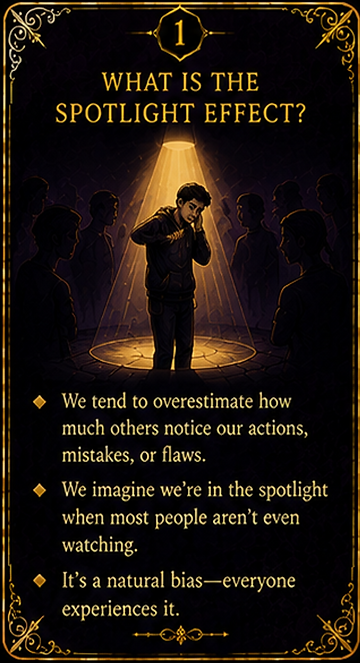
Spotlight Effect
What Is the Spotlight Effect?
The spotlight effect is a cognitive bias in which people tend to overestimate how much others notice their appearance, behaviour, or mistakes. Because we experience the world from our own perspective, it is easy to assume that others are paying as much attention to us as we are to ourselves. In reality, most people are focused on their own thoughts, concerns, and daily activities.
Researchers have shown that individuals consistently believe their actions or appearance are more noticeable than they actually are. Whether it's worrying about a bad haircut, stumbling over words during a presentation, or feeling embarrassed after making a small mistake, the spotlight effect can make these situations feel much bigger than they appear to others.
The interactive cards below explain why this bias occurs, illustrate it with everyday examples, and explore practical ways to become less self-conscious and more confident.
Key Takeaways
-
The spotlight effect is the tendency to overestimate how much other people notice us.
-
Most people are focused on their own lives rather than closely observing others.
-
The spotlight effect can contribute to unnecessary embarrassment and self-consciousness.
-
Recognizing this bias can help reduce anxiety and improve confidence in social situations.
Common Misconceptions
"The spotlight effect only happens to shy or anxious people."
Not true. The spotlight effect is a common cognitive bias that can affect anyone. While it may be more noticeable in people who experience social anxiety, most individuals occasionally overestimate how much attention others pay to them.
Why Does This Matter?
Understanding the spotlight effect can help people feel more comfortable in social situations, recover more quickly from embarrassing moments, and develop greater self-confidence. Recognizing that others are usually less focused on our mistakes than we imagine can make everyday interactions feel less stressful and more enjoyable.
References
Gilovich T, Medvec VH, Savitsky K. The spotlight effect in social judgment: An egocentric bias in estimates of the salience of one's own actions and appearance. Journal of Personality and Social Psychology. 2000;78(2):211–222.
Gilovich T. How We Know What Isn't So: The Fallibility of Human Reason in Everyday Life. New York: Free Press; 1991.